
Devils Roster Battle: Who Plays 3C, & What Does That Do to the Third Line?

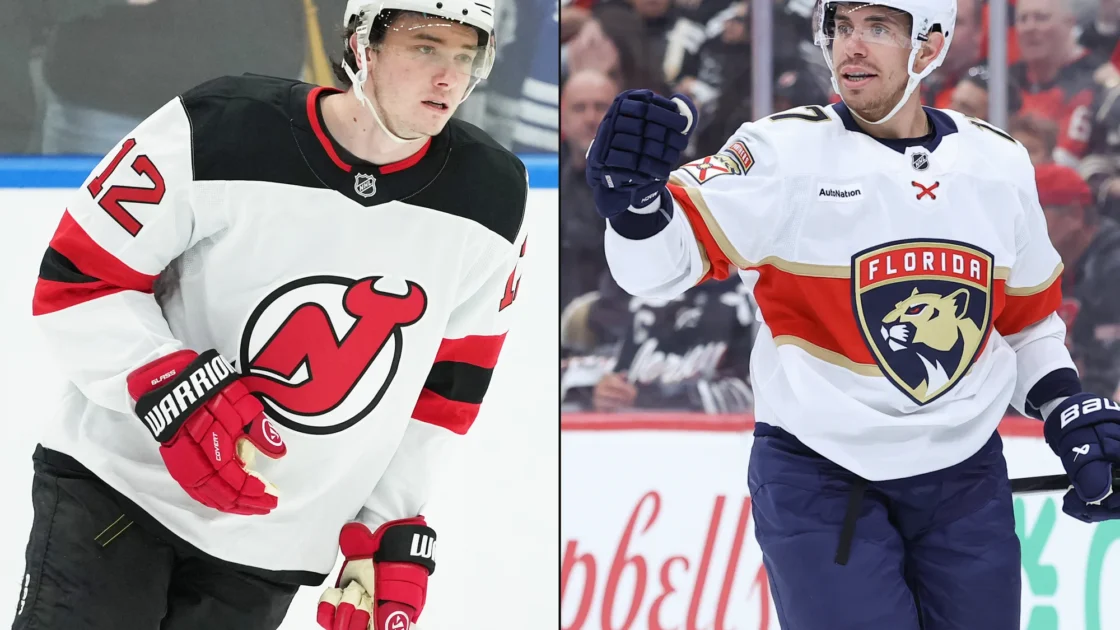
After the Summer of Sunny, the New Jersey Devils have plenty of options for their third-line center role. With training camp just around the corner, someone will need to claim it.
Jack Hughes and Nico Hischier are —obviously — not in this fight. The Devils’ third-line center job is up for grabs with Evan Rodrigues, Cody Glass, and Nick Bjugstad in the fight. Amadeus Lombardi is a long shot if camp gets loud. However, it’s more likely that only one of the veterans should open the season in that seat.
On paper, Rodrigues should be the leader.
Mehta did not trade for a 13th forward. He traded for a 33-year-old veteran who just played 17 minutes a night for the Florida Panthers, won two Cups in the two years before that, and can play the middle without turning the line into a faceoff clinic that cannot create anything after the draw. Glass is the better specialist. Bjugstad is the size extra. Lombardi is the kid who has to blow camp apart to change that. Those are real jobs. They are not this one.
The job, before the names
The Devils’ third line has to do three things. Start in its own end enough that Hischier is not doing all the dirty work. Move the puck up to Arseny Gritsyuk and Dawson Mercer without dying in the neutral zone. Produce enough that Sheldon Keefe does not hide it for 82 games.
Faceoffs matter, but they are not the whole job. If they were, Glass would already have it in ink and this column would be six paragraphs.
Glass took the real extra-center work in an average of 13:37 a night. Luke Glendening ate the rest before he left for Philly. Nobody on the current roster has played a full season as the third-line center behind Hughes and Hischier, although Glass was the mainstay. Mehta added Rodrigues to add to the depth. But, now there will be a fight and training camp has to pick one.
Anthony Mantha in July and Luke Evangelista last week cleaned up the top six. That is this offseason, not last year. The leftover question is who takes the next five-on-five middle so Mercer can stay on the wing and Gritsyuk is not dragging a checker.
Rodrigues
Sixty-nine games in Florida last season. Eleven goals, 20 assists, 31 points, 17:00 a night. He took 791 faceoffs and won 47.0 percent. Clearly, that is not Glass’ win rate. It is also not a reason he can’t win the role. He spent two Cup runs playing the exact style Keefe wants on a third line: keep the puck, find the next man, don’t make the shift smaller than it has to be. Fifteen points in the 2024 playoffs. Fifteen more in 2025. Plus-26 in the 2023-24 regular season on a team that actually played with the puck.
Last year was messier. Minus-16. Shot 6.9 percent. The Panthers were a different team due to a plethora of injuries and his minutes went up anyway, from 15:10 and 15:13 in the Cup years to 17:00. That jump is the tell. Paul Maurice still gave him third-line and up usage when the roster got thinner. Possession stayed excellent — 55.4 percent Corsi. He is not a passenger you hide. He is a right-shot center who can play the wing tomorrow if Glass needs a night up in the lineup.
The knock is the obvious one. The finishing is ordinary. He will lose some draws Glass would win. Fine.
The third line next to Gritsyuk and Mercer does not need a sub-14-minute per night center. It needs a center who can play 16 minutes without shrinking his wingers. Rodrigues has done that on better teams than this one.
Glass
Seventy games. Nineteen goals. Seven assists. Twenty-six points. 13:37 a night. 54.0 percent on 896 draws.
That last number is why people want him at 3C. It is the best argument he has, and it is a real one. Hischier was at 55.8. Everybody else on the roster was a step down. If the only question is who wins a defensive-zone draw against the other team’s third-line center, Glass wins this column.
The rest of the résumé is a fourth-line year with a hot finishing rate. Eighteen-point-one percent shooting does not live in the third-line middle for 82 games. Seven assists in 70 games is not a driver. Thirteen minutes a night is the usage that made the 19 goals possible. Stretch him to 16 against better extras and you are betting the goals stay while the process does not. If Glass can up his minutes, he wins the third-line center battle
What Glass is: a right-shot center with an underrated shot who can sneak a goal from a short leash and take the important draws on a fourth line that already has Connor Brown on the penalty kill. Again, if he can up his minutes, he can help drive a line like he did with Gritsyuk last season that made the Devils’ third line work so well.
If Rodrigues looks a step slow in the first week of camp, Glass is the first call. That is different from handing him the job in September because the faceoff sheet is tidy.
Bjugstad
Six-foot-six. Thirty-four. Nine points in 61 games last season, split between St. Louis and New Jersey.
The Devils portion is the one that matters. Twenty-six games, zero goals, two assists, 10:00 a night, 46.1 percent on draws. Before the trade he had six goals in 35 games for the Blues and won 51.1 percent. Even that is a fourth-line, matchup-heavy number. It is not a 3C number on a team that just spent a first-round pick to make the top six real.
Bjugstad’s job is the night Keefe wants a big body in the crease and a veteran who will not get scored on in the last four minutes. He can take a draw. He can kill a penalty. He cannot play with Gritsyuk and Mercer without turning that line into a checking unit that needs to be sheltered. Writing him in at 3C so the depth chart looks “hard to play against” is how you waste two skill wingers.
He is the extra. He is a useful extra. He is not in this race unless Rodrigues and Glass both get hurt.
Lombardi, if camp gets loud
Lombardi is the name you write in pencil and keep off the opening-night graphic.
He can play the middle. He has pace. He is the kind of camp story that makes a crowd get ahead of itself after one good rookie game against the Islanders. If he looks like the best center on the ice for a week, Keefe has to give him a look with the veterans. That is the dark horse. It is also the exception, not the plan.
The likelier path is Utica. New Jersey is tight to the cap, the waiver situation is real, and there are already three NHL centers who can take the job without asking a first-year regular to survive October in the Metro. Lombardi beating Rodrigues and Glass for 3C would mean both veterans failed in front of the staff. That is worth watching. It is not the projection.
If he makes the Devils roster, the collateral is ugly in a different way. Jesper Boqvist can become the extra, Bjugstad and Stefan Noesen are even further down, and the organization has decided a kid is more trustworthy than the veteran players. I would need to see it for more than two scrimmages.
What the choice does to Gritsyuk
Gritsyuk is the collateral people will may overlook here. Don’t.
Thirteen goals and 18 assists in 66 games as a first-year NHLer, 15:10 a night. Mehta paid to keep him. The third-line left wing is the promotion that does not require stealing Evangelista’s minutes. It only works if the center can play.
Rodrigues next to him is a possession center who has lived in that layer. Gritsyuk can retrieve, cut to the middle, and not have every shift start with a lost draw and a dump-in. Glass next to him is more draws and less playmaking after the puck is won. Bjugstad next to him is a checking line with a skill winger trapped on it. Lombardi next to him is a bet that camp tape is enough.
If you believe Gritsyuk is a real NHL scorer — and there’s plenty of reason to — you do not give him the 3C who cannot move. That is the quiet half of picking Rodrigues. It is not loyalty to a new incoming. It is putting the 25-year-old in a spot where his second year can be one where he continues to grow.
What the choice does to Brown
Brown scored 18 goals and added 25 assists for the Devils in 75 games last season, a lot of it in Hughes’ orbit when the top six needed a body. It’s unlikely he’s going back there. Mercer has the third-line right wing. Mantha and Evangelista closed the top six this summer. Brown’s honest home is the third or fourth-line right side with PK1.
Rodrigues at 3C makes that cleaner. Glass goes to the fourth-line middle, keeps the draws, and Brown plays next to a center who already knows that layer. The fourth line becomes Boqvist–Glass–Brown. That is a luxury fourth unit. Skill on one side, faceoffs in the middle, the Swiss-Army knife on the right.
Glass at 3C kicks Rodrigues down or out of the middle and forces a different fourth line. You can put Rodrigues on the wing next to Glass, which wastes the center you just traded for. Or you put Bjugstad there and ask Brown to drag a checking line. Either way Brown’s usage gets sloppier.
Bjugstad at 3C is the worst version for Brown. The third line gets heavy. The fourth line loses its faceoff man. Brown ends up covering for two centers who are playing out of their best spots.
Lombardi at 3C would shove Boqvist into a pile Brown does not want to sort out in October.
The Devils penalty kill does not care who wins 3C as much as the five-on-five does. PK1 is still Hischier and Brown. PK2 is still Mercer and Glass. Rodrigues takes a look. Bjugstad is the big body if you want that night. None of that requires Bjugstad to take third-line even-strength minutes.
The line if Rodrigues wins
Gritsyuk–Rodrigues–Mercer
Boqvist–Glass–Brown
Mercer stays on the wing. Glass stays in the minutes that made him useful. Bjugstad stays in the extras with Noesen and Lenni Hämeenaho. Lombardi starts in Utica unless he forces the issue. That is the version that matches what Mehta bought and what Keefe has actually deployed in the league.
What would change the call
Rodrigues looks a step slow for a week and Glass’s five-on-five holds up. Then Glass takes 3C and Rodrigues slides to the fourth-line wing or a matchup spot.
Glass’ shooting dies immediately and Rodrigues is fine. You stay the course. Nineteen goals was the mirage. The draws still play on the fourth line.
Lombardi is the best center on the ice through the rookie games and the first veteran scrimmages. Then you give him a preseason look. You do not hand him opening night because one New York Islanders game was fun.
Somebody gets hurt up top. Rodrigues can play the wing in the Devils’ top-six next to Hischier or Hughes for a night. That flexibility is part of why he is the leader. Glass can move up to 3C. Bjugstad cannot do it without shrinking the line.
The call
Play Rodrigues. Not because he wins the most faceoffs. Because the third line is a hockey line, not a draws spreadsheet, and he is the only veteran in the group who has played that layer on a team that won anything. The Devils’ depth last year wasn’t present last year. Rodrigues changes the game entirely.
Glass is the 4C. Bjugstad is the extra. Lombardi is the Utica center unless camp gets loud enough to make this column look cautious. Gritsyuk gets a center who can play. Brown gets a fourth line that still has a faceoff man. Camp can flip it.
The Devils’ opening projection should not.